The Anatomy of Your Lymphatic System
What Actually Makes Up The Lymphatic System?
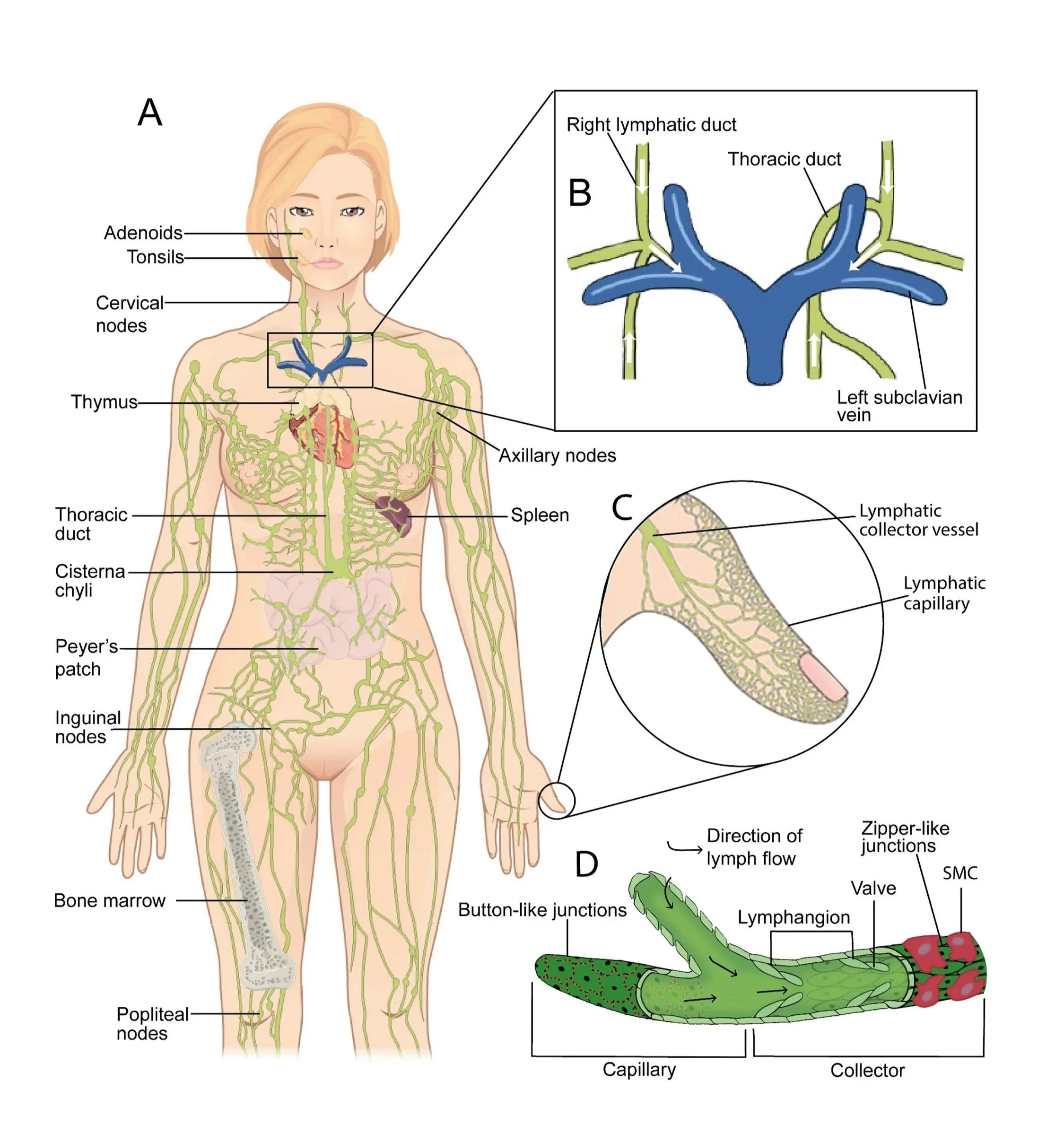
By SGUL lymres - Own work, CC BY-SA 4.0, https://commons.wikimedia.org/w/index.php?curid=99532989
The lymphatic system is a complex network of vessels, capillaries, and trunks that moves fluid from body tissues, filters it through lymph nodes, and eventually returns it to the bloodstream via the subclavian veins (see image - upper right corner).
Where are lymph vessels located?
Just beneath the skin, within the dermis and subcutaneous tissue, delicate lymphatic capillaries and vessels collect excess fluid from tissues. Unlike the cardiovascular system, the lymphatic system has no central pump like the heart. Instead, lymph moves through the body by gentle contractions of lymphatic vessels, muscle movement, breathing, and changes in tissue pressure. External techniques such as Manual Lymphatic Drainage (lymphatic massage) can also help encourage lymph movement along its natural pathways toward the lymphatic ducts and back into the bloodstream.
Where are lymph nodes located?
Surprisingly, most of the body’s lymph nodes are found in the abdomen. The largest groups closer to the surface are located in the neck, with additional clusters in the armpits, groin, elbows, behind the knee, and near the ankles.
Lymph typically flows toward the closest lymph nodes.
Many people assume that lymph simply flows toward the heart, but this isn’t true. Let’s trace the lymph from the toes all the way to the neck, where it enters the bloodstream:
From the toes, lymphatic capillaries collect excess interstitial fluid and pass it into larger lymphatic vessels.
The lymph travels through the vessels toward the popliteal lymph nodes behind the knee, and then to the inguinal lymph nodes in the groin,
It then continues through deeper lymphatic vessels and trunks into the pelvis and abdomen.
From there, lymph travels upward through the thoracic duct deep in the chest, which carries it before emptying it into the venous circulation at the left subclavian vein.
How Does Lymphatic Massage Work?
Lymphatic massage using the Vodder Technique, also known as manual lymphatic drainage (MLD), uses gentle, rhythmic movements to stretch the skin and superficial tissues, where many of the initial (superficial) lymphatic vessels are located. This type of massage closely follows the anatomy, which is why it is such an effective technique.
The gentle strokes applied during MLD can stimulate the lymphatic vessels and support lymphangiomotion—the natural, rhythmic contractions of the lymph vessels that help propel lymph forward. The technique also uses specific directional movements to encourage lymph toward functioning lymphatic pathways and lymph nodes, following the anatomy we just discussed.
MLD is slow and rhythmic. Each movement consists of a gentle pressure/stretching phase followed by a relaxation phase. During the relaxation phase, superficial lymphatic vessels can refill with fluid from surrounding tissues; during the subsequent pressure phase, the tissues and lymphatic vessels are gently deformed, helping move lymph toward the next portion of the lymphatic pathway.
The movements are performed at a rate of 1 stroke per second to allow each lymph vessel portion, known as a lymphangion (see image - bottom right corner), to empty and refill. When using the Vodder Technique, I carefully control the rhythm and sequence of each movement, using these anatomical principles, rather than using the deeper, faster pressure commonly associated with conventional massage.